
In a praiseworthy move, the Govt of India has restructured the entire Medical Education system in India to bring about a uniformity that was very necessary. So, as a part of this revamping, the NEET UG Exam conducted by NTA (National Testing Agency) replaced the former AIPMT exam in 2017. It took almost 5 years of hearings of multiple petitions by the Supreme Court to eventually scrap off the AIPMT exam. Currently, the aspirants get the seats in medical colleges in India, specifically the MBBS and Dental seats, on the basis of his/her rank in the NEET UG exam. In addition to this, all the States and Union Territories allocate the seats of BAMS, BHMS and other alternative medicine courses on the basis of NEET UG rank only.
Though the MBBS abroad option is gaining immense focus in India lately – a surprising number of 18000+ students opt for MBBS thru this route every year – the established path to practice medicine here is through completion of MBBS degree in India. MBBS expands to Bachelor of Medicine and Bachelor of Surgery and duration of MBBS in India is 5.5 years, including 1 year of internship.Being perhaps the noblest and the most lucrative of professions, the field of medicine attracts a substantial section of the Indian youth. Due to the ubiquitous popularity of MBBS, the number of medical colleges in India offering MBBS course is quite high – more than 550! However, getting medical admission in India is just as challenging as it is prestigious to be a doctor here. National Eligibility cum Entrance Test UG (Abbreviated as NEET UG) is the only MBBS Entrance Exam in India and as a result, lakhs of students take the NEET UG exam every year but due to limited seats, only a small percentage of the test-takers succeed.
There are 554 Indian medical colleges to be precise. Among these, 285 are Government medical colleges in India for MBBS and rest, i.e. 269, are private Medical Colleges. There are 83,175 total MBBS seats in India 2021: 43,335 of the total seats available for MBBS in India are held by the government medical colleges and the remaining 39,840 seats exist in private medical colleges. Keeping in view the enormous popularity of MBBS and in order to cope with the ever-increasing figures of NEET UG test-takers, new medical colleges in India are coming up at an exponential rate. In the last 10 years alone, 243 medical colleges in India have been established which account for nearly 45% of the total Medical Colleges. Karnataka has the highest count of MBBS seats among all Indian states with 9345 MBBS seats followed by Maharashtra (9000), Tamil Nadu (8000) and so on.
Not just MBBS, India also has a great scope of postgraduate medical education as well. Collectively, 436 colleges in India efficiently run Medical PG courses (MD/MS/Diploma) and the number of medical PG seats in India in clinical and non-clinical streams are 38,000+. Then there is ample opportunity of pursuing super specialties in India, with 179 colleges offering 4,400+ seats under DM/MCH programs.
| Year | MBBS Colleges | MBBS Seats | No Of Neet Application | Increase in Applications* | Success Rate (Govt. Medical Colleges) | Success Rate (Govt. + Private Medical Colleges) | ||||
|---|---|---|---|---|---|---|---|---|---|---|
| govt. | private | total | govt. | private | total | |||||
| 2017 | 218 | 232 | 450 | 35870 | 34290 | 70160 | 11.39 Lacs | +42% ↑ | 3.14% | 6.16% |
| 2017 | 218 | 232 | 450 | 35870 | 34290 | 70160 | 11.39 Lacs | +42% ↑ | 3.14% | 6.16% |
| 2017 | 218 | 232 | 450 | 35870 | 34290 | 70160 | 11.39 Lacs | +42% ↑ | 3.14% | 6.16% |
| 2017 | 218 | 232 | 450 | 35870 | 34290 | 70160 | 11.39 Lacs | +42% ↑ | 3.14% | 6.16% |
| 2017 | 218 | 232 | 450 | 35870 | 34290 | 70160 | 11.39 Lacs | +42% ↑ | 3.14% | 6.16% |
*in comparison to the previous Year
The table sums up how the MBBS colleges in India have increased with the growing number of NEET UG applicants. Click here to find the list of medical colleges in India .You can see that the rise in the number of colleges isn’t enough to accommodate the Medical aspirants every year. Consequently, despite the addition of 83 Colleges (61 Government and 22 Private) between 2017 2020, the success rate of getting admission to government colleges for MBBS in India has dropped from 3.14% to 2.67%. Hence, we may conclude that the number of MBBS colleges in India does not meet the number of youngsters with dreams of becoming doctors.
Owing to the skewed ratio between the numbers of aspirants seats in medical colleges in India, a candidate has to score really good NEET marks for government college seat. The competition becomes cut throat due to this. As a result, students take multiple attempts to get good marks and in the process, add to the already ruthless competition. Those who do not make it to a government medical college and those who can afford it, seek admission in private medical colleges. Now, in India, MBBS fees in a Private College is very high but most of the Private Medical college in India aren’t even experienced enough to provide the quality of education to their students Vs money paid to them. Therefore, a gap indeed exists in the picture.
Fortunately, those who are able neither to score sufficiently well in NEET UG to get a seat in a Govt. Medical college nor afford the kind of money needed to buy the seat in Private medical college in India, have the option of choosing the MBBS Abroad path.
| Name Of State / Union Territory | Total MBBS Colleges | Total MBBS Seats | ||||
|---|---|---|---|---|---|---|
| govt. | private | total | govt. | private | total | |
| Andhra Pradesh | 13 | 18 | 31 | 2410 | 2800 | 5210 |
| Andhra Pradesh | 13 | 18 | 31 | 2410 | 2800 | 5210 |
| Andhra Pradesh | 13 | 18 | 31 | 2410 | 2800 | 5210 |
| Andhra Pradesh | 13 | 18 | 31 | 2410 | 2800 | 5210 |
| Andhra Pradesh | 13 | 18 | 31 | 2410 | 2800 | 5210 |
For further clarity, here is the graphic representation of the number of colleges in each Indian state:
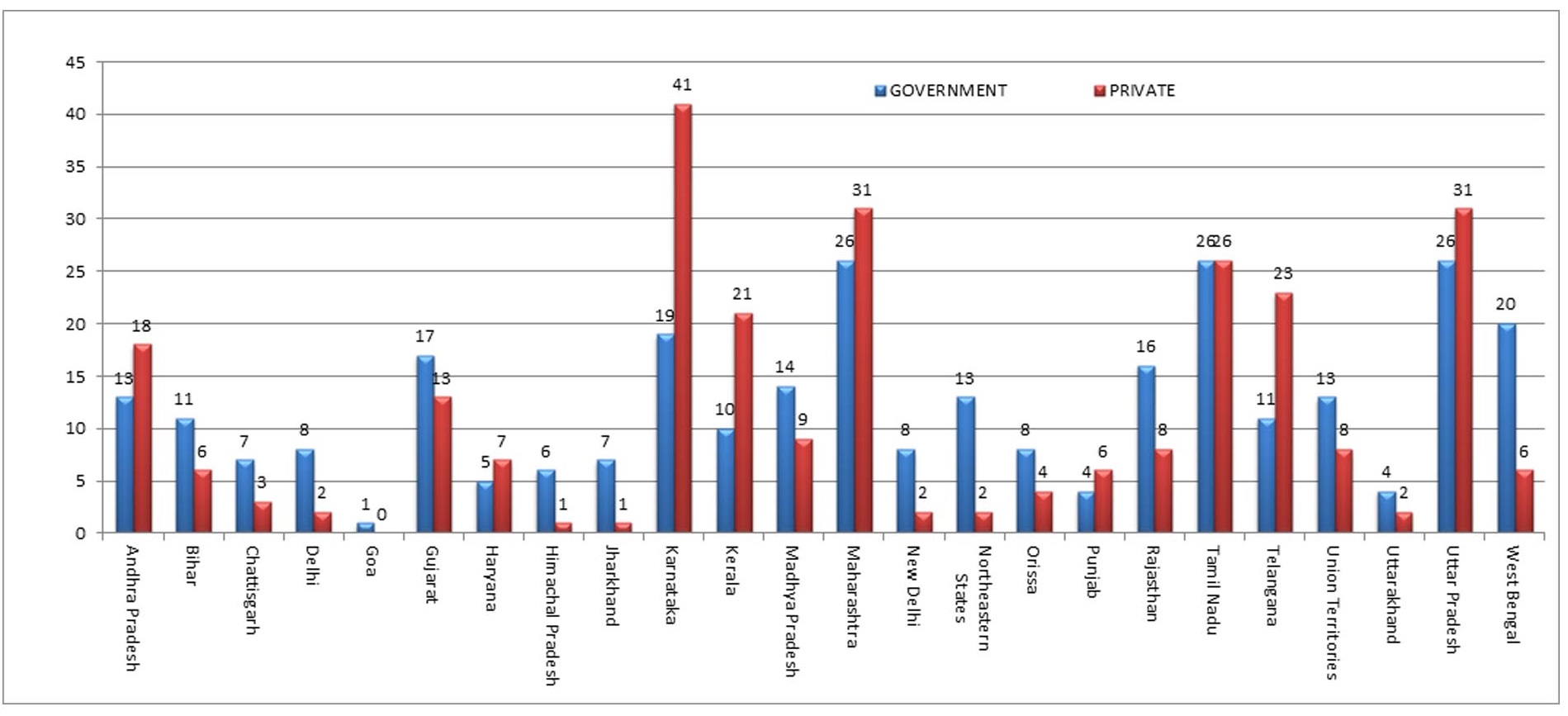
Please note that we have depicted all the Northeastern states of India (Arunachal Pradesh, Assam, Manipur, Meghalaya, Mizoram, Sikkim and Tripura) and the Union Territories (excluding Delhi) as single units for ease of perception.
Indian Medical Colleges Teaching ExperienceAs mentioned above, in its mission to substantiate the medical infrastructure, the Govt. has established 224 (Govt. + Private) new Medical colleges in India in the last 10 years. This number is around 40% of the total medical colleges in India. But we are still facing challenges in finding the suitable teaching faculty. When it comes to educational institutions, it is an established fact that those colleges/universities with a good number of years of experience are always better. They have a strong academic background and well-experienced teachers. In case of the newly established medical colleges, it becomes hard to find the right faculty whose pedagogical abilities are at par with the standards set by NMC (Regulatory body of medical education and medical professionals). Consequently, as many as 50% posts of teaching faculty positions in these new medical colleges are vacant which leads to challenges in students’ learning process.
Copyright Best Career. All Rights Reserved. Design & Developed By Website Xpert